
Students reimagine a “New Central Pier” as Docklands waits for its next act
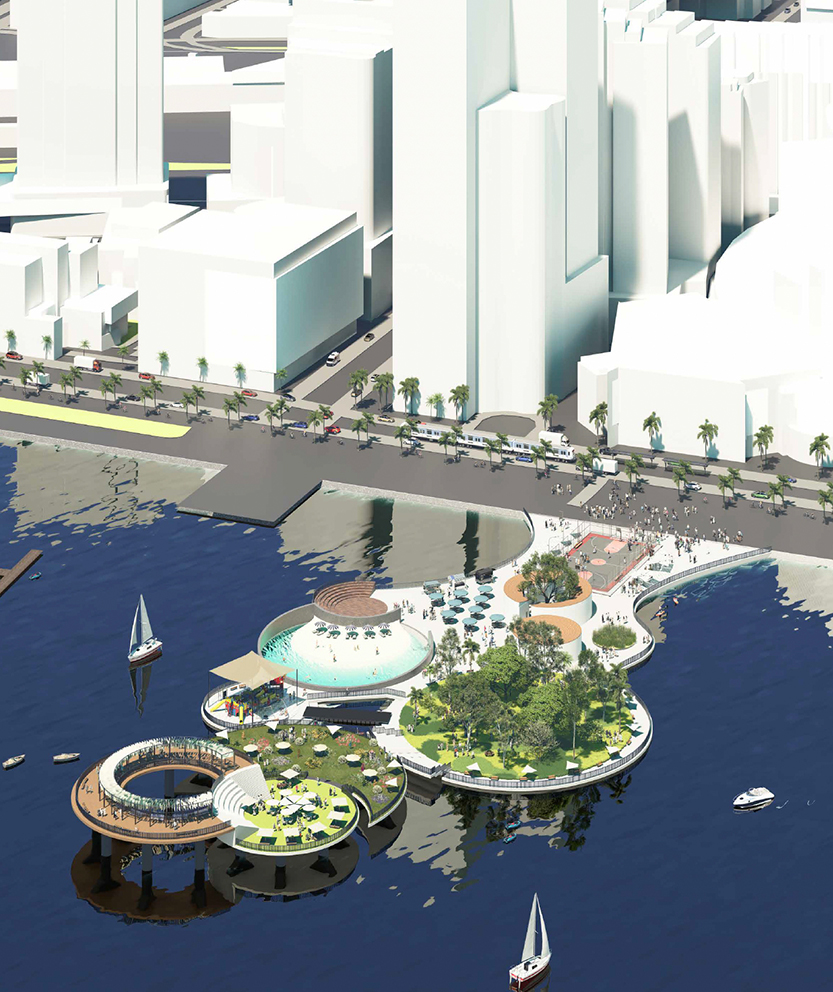

With Central Pier now gone and Victoria Harbour sitting unusually open to the sky, a question lingers over Docklands: what, if anything, should come next?
While the state government’s financial constraints and the AFL’s long-term plans for the waterfront edge of Marvel Stadium mean any formal redevelopment is on hold, a group of University of Melbourne architecture students have spent the summer imagining bold futures for the site.
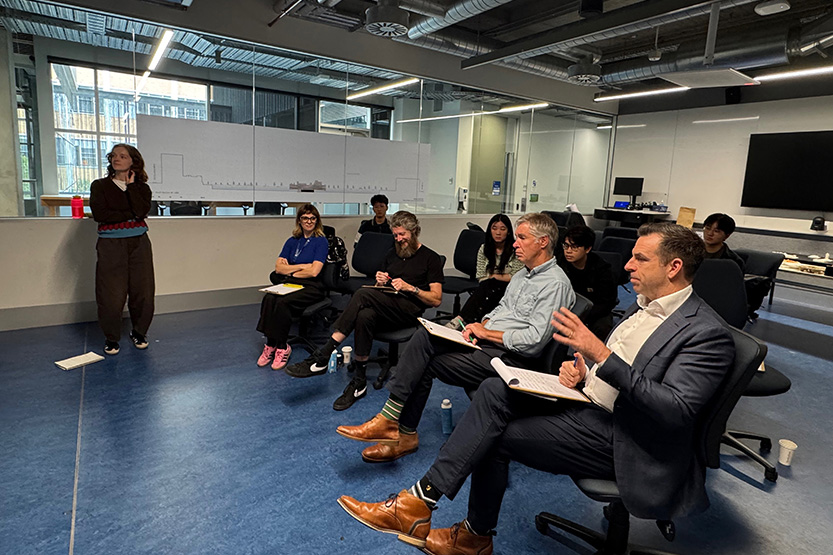
And in a sign that the conversation is far from over, Development Victoria’s executive general manager of precincts Niall Cunningham attended their final presentations, offering feedback and probing questions.
The speculative studio, led by Professor Donald Bates – co-founder of LAB Architecture Studio and a key figure behind Federation Square – asked 12 Master of Architecture students to consider a “New Central Pier” from scratch.
"We want them to be confronted with a quote unquote ‘real project’, but also to use it as an opportunity to propose something that’s never been, never existed before or even thought of before," Prof. Bates told Docklands News.
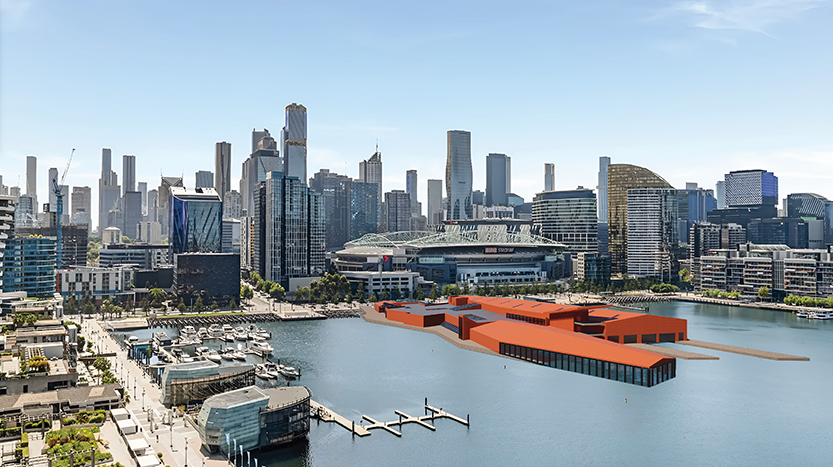
Central Pier, built between 1916 and 1919, was closed in 2019 due to structural collapse risks and fully demolished by August 2025. As one student’s project timeline shows, the site has shifted from industrial dock to hospitality hub to absence – creating what the studio described as a “Tabula Rasa Aqua” (blank slate) moment.
For Prof. Bates, a Docklands resident, the absence itself became the catalyst.
“In a class when you have 12 students or more, you get 12 completely different responses to the same question,” he said. “There was no, ‘here’s what you have to do’.”
The first third of the semester was spent researching the 140-year history of Victoria Harbour – from the cutting of the Coode Canal to Docklands’ 1990s renewal – and examining global precedents, from Copenhagen’s harbour baths to New York’s Hudson River piers.
“Docklands are still a work in progress,” the studio brief noted, asking students to consider what essential element might be missing from the precinct.
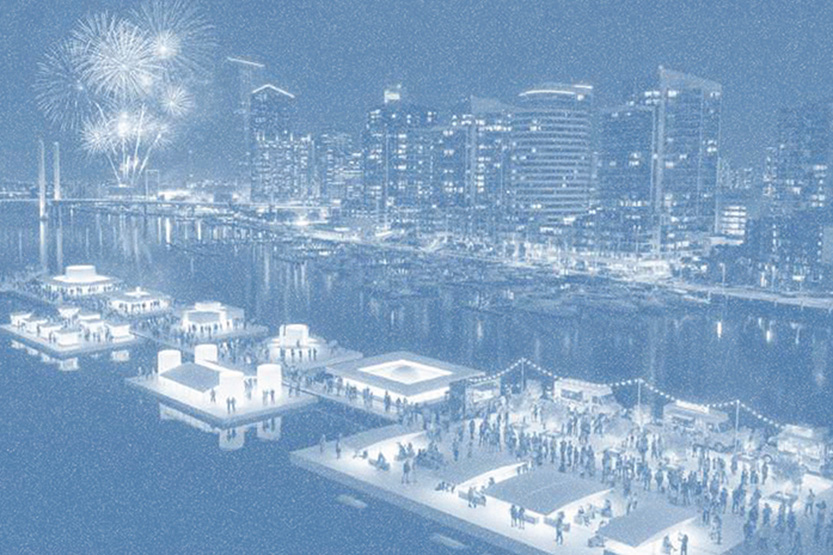
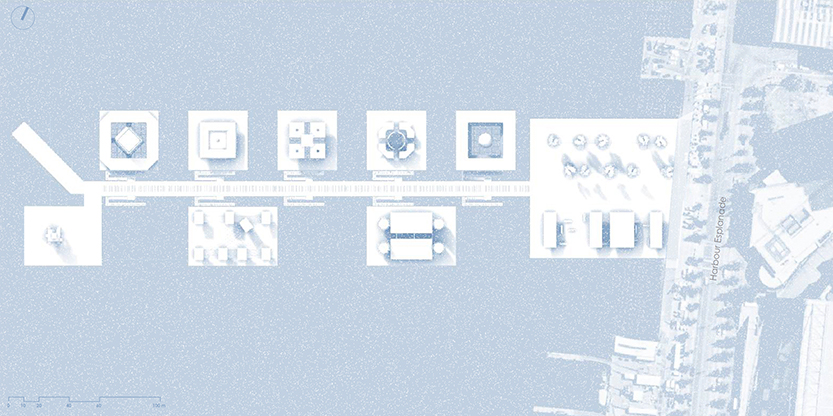
Among the six projects highlighted, Daniel Lau’s proposal stands out for its modular logic. His floating pavilions, designed for events and cultural programming, could be towed to Williamstown, Princes Pier, St Kilda or even Point Nepean – physically linking Victoria Harbour to other waterfronts.
“They start to tell different kinds of narratives, almost sort of symbolic sets of relationships,” Prof. Bates said. “But importantly, linking Victoria Harbour itself as a physical space with other physical spaces.”
For a precinct often criticised for its isolation from the rest of Melbourne, that gesture feels particularly resonant.
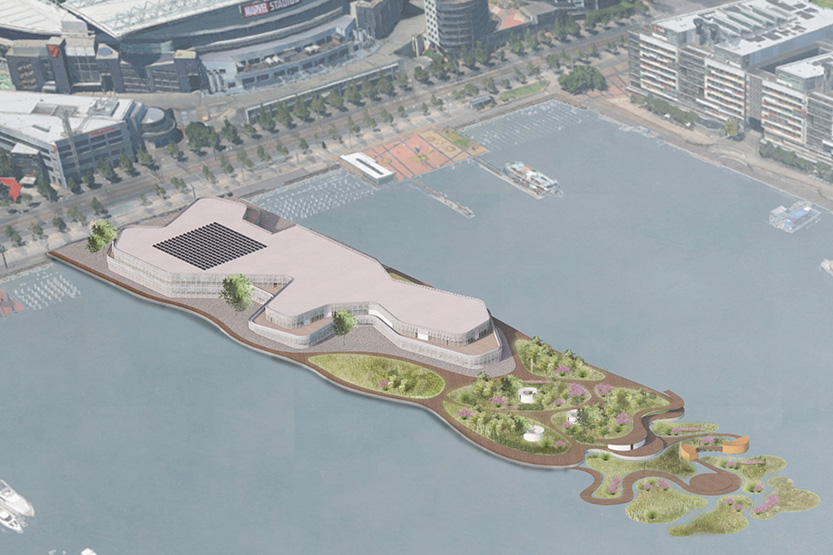
Maisie Matthews’ project, The Harbour Baths, takes a different tack, envisioning a wellness precinct with a kilometre-long running track, outdoor pool, saunas and wetlands seeded with oyster beds to filter harbour water. In light of the City of Melbourne signing the swimmable cities charter, the idea of reintroducing swimming to the harbour no longer feels fanciful.
“There were questions around, well, what happens with global sea rise, and so what do you pick as a datum?” Prof. Bates said. “Is it completely floating on the water? So, if sea levels do rise, it doesn’t matter because it just rises with it?”
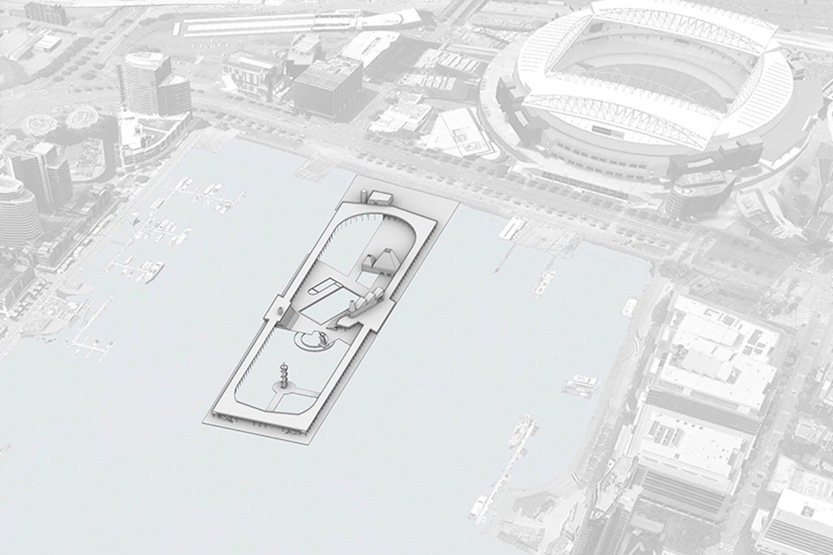
Other proposals include a working maritime museum with boat repair workshops and underwater galleries, a surf and swim park, a brewery-led activation hub, and a park concept that evokes New York’s Little Island. The Docklands Maritime Centre project, for example, combines heritage boat conservation, museum galleries and hospitality spaces into what it describes as “a civic maritime infrastructure”.
Crucially, the students were not constrained by a development brief or cost envelope.
“They weren’t operating under a cost parameter. It was really about letting the students keep open,” Prof. Bates said.
Yet realism was not entirely absent. Students were required to document how their projects would be constructed, serviced and staged over time. The presence of Development Victoria added another layer.
Architects Hamish Lyon (NH Architecture) and Laura Martires (Common) also attended the presentations alongside several other academics.
“Being able to have people from the outside, from the profession, come in and look at the work and critique it, and say, ‘really? Are you sure you want to do that?’ Ask those kinds of tough questions,” Prof. Bates said. “But at the same time, you get some amazing feedback from Development Victoria who go, ‘wow, we hadn’t thought about that’.”
That exchange is telling. With speculation swirling about whether Central Pier will return in any form, Mr Cunningham’s attendance suggests Development Victoria is still listening – even if formal plans are paused.
Docklands News understands that the State’s broader fiscal pressures, coupled with the AFL’s longer-term ambitions around Marvel Stadium’s waterfront edge, mean progress is unlikely in the short to medium term. For now, many residents are enjoying the openness of the harbour without the pier’s bulk.
But that openness is not necessarily a celebration of permanent absence. For some, it feels more like a clearing of the stage.
The risk for Docklands has always been locking in a future that creates new challenges rather than resolving old ones – whether through under-activation, over-commercialisation or a failure to serve its significant residential population.
Prof. Bates sees value in asking difficult questions early.
“When they start sitting down and they have to work it through and make it make sense, means they have to really develop the kind of narrative of why you would do this and what does it provide and what are the consequences and what are the short-term and the long-term consequences of doing something like that?” he said.
Federation Square was once a controversial idea sketched in studios and competitions before it redefined Melbourne’s civic heart. Central Pier may never return in its former footprint. But as these students have shown, imagination remains one of Docklands’ most underutilised assets.
And sometimes, the most transformative ideas begin without bureaucratic strings attached. •
Image1: Central Pier by student Shuaiqi Wang
Image 2: Maritime Museum concept by Thomas Sun
Image 3: The Harbour Baths by Maisie Matthews
Image 4: The modular concept by Daniel Lau
Image 5: Central Pier Park by Hunhee Lee
Related Articles
Lendlease’s Docklands build-to-rent tower reaches full height
Lendlease’s latest build-to-rent development has topped out at 899 Collins St, marking a major construction milestone for the 24-storey waterfront project in Docklands.
Read More
Tram bridge to E-Gate still possible despite West Gate Tunnel fears
A long-mooted tram connection linking West Melbourne to E-Gate and Docklands remains technically feasible despite the construction of the West Gate Tunnel Project’s Wurundjeri Way extension, Docklands News can reveal.
Read More
Good Cycles departs Docklands bike hub after decade on Harbour Esplanade
The Good Cycles bike hub on Harbour Esplanade has closed after almost a decade in Docklands, opening up a new opportunity for the City of Melbourne and Development Victoria to rethink one of the waterfront’s most visible small-scale activation sites.
Read More
Pam the Bird disappears from Bolte Bridge following chaotic Docklands scenes

Meals with Impact launches free Docklands food market

 Download the Latest Edition