
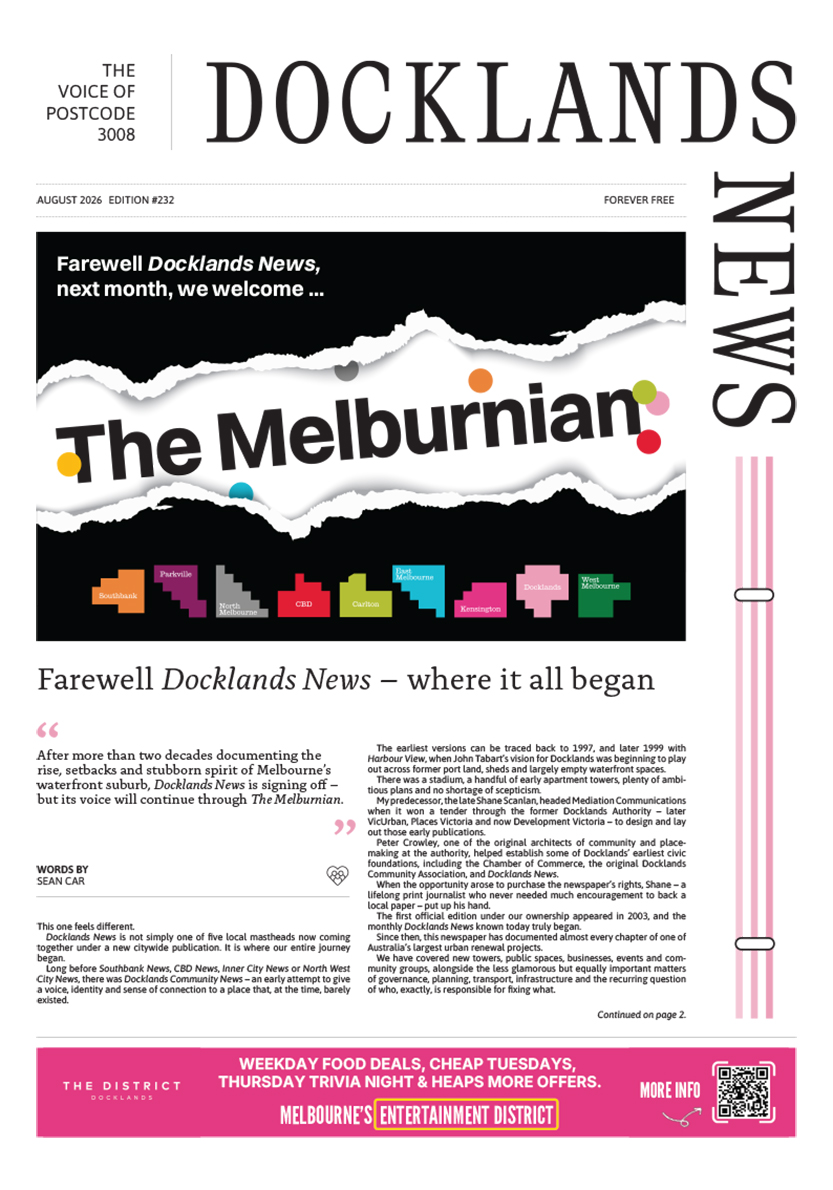
Farewell Docklands News – where it all began
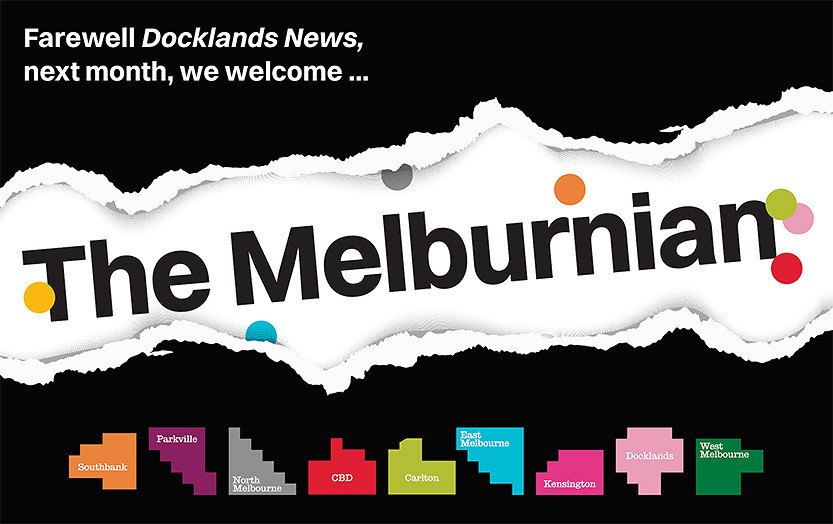

After more than two decades documenting the rise, setbacks and stubborn spirit of Melbourne’s waterfront suburb, Docklands News is signing off – but its voice will continue through The Melburnian.
This one feels different.
Docklands News is not simply one of five local mastheads now coming together under a new citywide publication. It is where our entire journey began.
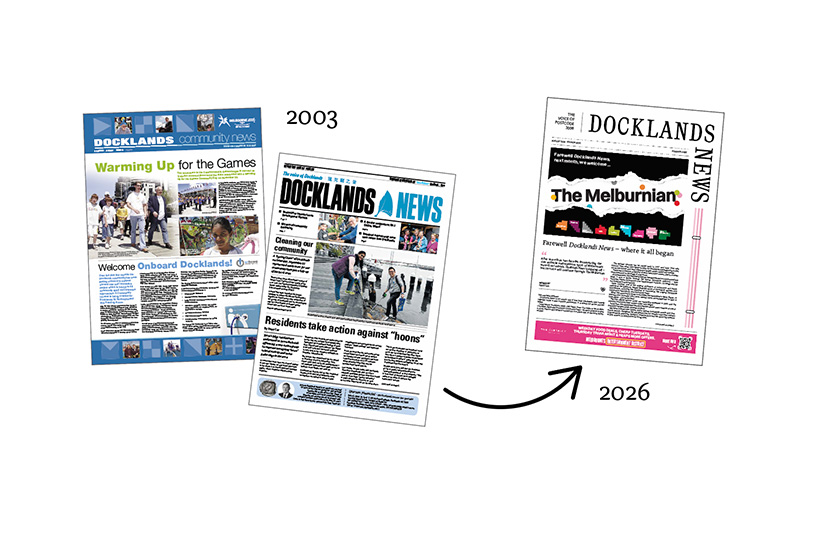
Long before Southbank News, CBD News, Inner City News or North West City News, there was Docklands Community News – an early attempt to give a voice, identity and sense of connection to a place that, at the time, barely existed.
The earliest versions can be traced back to 1997, and later 1999 with Harbour View, when John Tabart’s vision for Docklands was beginning to play out across former port land, sheds and largely empty waterfront spaces.
There was a stadium, a handful of early apartment towers, plenty of ambitious plans and no shortage of scepticism.
My predecessor, the late Shane Scanlan, headed Mediation Communications when it won a tender through the former Docklands Authority – later VicUrban, Places Victoria and now Development Victoria – to design and lay out those early publications.
Peter Crowley, one of the original architects of community and placemaking at the authority, helped establish some of Docklands’ earliest civic foundations, including the Chamber of Commerce, the original Docklands Community Association, and Docklands News.
When the opportunity arose to purchase the newspaper’s rights, Shane – a lifelong print journalist who never needed much encouragement to back a local paper – put up his hand.
The first official edition under our ownership appeared in 2003, and the monthly Docklands News known today truly began.
Since then, this newspaper has documented almost every chapter of one of Australia’s largest urban renewal projects.
We have covered new towers, public spaces, businesses, events and community groups, alongside the less glamorous but equally important matters of governance, planning, transport, infrastructure and the recurring question of who, exactly, is responsible for fixing what.
We reported the closure of Central Pier and the Melbourne Star, and now the Star’s unlikely return. We followed the long-awaited opening of Docklands Primary School, the tram bridge and freight bridge sagas, and the bureaucratic struggles that continue to shape the precinct.
During COVID, when Docklands was among the hardest-hit communities in Australia, we documented a suburb emptied of workers, visitors and events almost overnight.
Through all of it, Docklands News advocated for and championed this place when few others would.
Shane summed up that position with a phrase he repeated at almost every speaking opportunity: “I think Docklands is beautiful.”
It was a simple but emphatic response to the years of criticism directed at the suburb by commentators, “knockers” and mainstream media outlets that rarely seemed interested in understanding the place beyond its latest setback.
Shane, like Docklanders themselves, understood that the suburb’s real character was found in its people.
When I first arrived as an intern in 2013, I immediately recognised the newspaper’s staunch advocacy and its role in bringing people together. As someone already passionate about community building and local media, that facilitative approach resonated strongly.

Shane and I went into business together in 2018 to form Hyperlocal News, before he retired in 2019. Since then, we have expanded our coverage across the City of Melbourne and part of the City of Port Phillip, but Docklands has remained our foundation.
It is bittersweet to send this final edition to print while so many longstanding issues remain unresolved.
Harbour Esplanade still falls well short of its potential. Victoria Harbour remains underused. The community continues to wait for vital infrastructure, including a secondary school, and the suburb desperately needs more greening and better public spaces.
Yet recent developments give me genuine confidence.
Community3008 has emerged as a strong and constructive residents’ voice, while the renewed Docklands Chamber of Commerce has demonstrated what local businesses can achieve through initiatives such as its highly successful waterfront market.
Docklands is now home to nearly 20,000 people, with more to come. Its future will depend on residents and businesses continuing to organise, collaborate and drive change together.
Perhaps the return of the Melbourne Star’s lights is a fitting symbol. It is quirky, unmistakably Docklands and closely tied to the suburb’s changing fortunes.
May its return signal brighter days ahead.
There are too many people to thank properly, but I will try.
Thank you to our readers, who picked us up, wrote to us, corrected us, encouraged us and occasionally gave us a very direct piece of their mind.
Thank you to our advertisers, whose support made this work possible.
Thank you to the City of Melbourne, community groups, traders, residents, artists, advocates and contributors who trusted us with their stories.
And thank you to my team, past and present – Lauren, Kate, Jenny, Chris, Hanna, and our amazing distributors who have canvassed every corner of this city to make sure the paper gets where it needs to go.
Our team has been proud to play a role in this community’s growth. Docklands News may be ending, but our commitment to Docklands is not.
From September, that work continues through The Melburnian.
We have loved the journey.
And we look forward to continuing it.
Sean Car - Publisher and Editor
Hyperlocal News •
Pam the Bird disappears from Bolte Bridge following chaotic Docklands scenes
Meals with Impact launches free Docklands food market

 Download the Latest Edition