
When an unexpected expense hits: What your borrowing options actually look like in Australia

Most people's financial planning accounts for the expected. Regular bills, known commitments, the expenses that appear on the same date every month.
What it rarely accounts for with the same precision is the unexpected, and the unexpected has a way of arriving at the worst possible moment. A car that fails its roadworthy on the way to work. A dental emergency that can't wait for the next pay cycle. A plumbing fault that turns a minor inconvenience into a significant repair bill before the end of the week.
The financial gap that unexpected expenses create is one that most Australians navigate at some point, and the options available for bridging it are worth understanding before the situation is urgent rather than after. Borrowing decisions made under time pressure and financial stress are rarely the most considered ones, and the people who know what their options look like in advance consistently make better choices than those discovering them for the first time when the pressure is already on.
The kinds of expenses that create genuine financial urgency
The situations that most commonly push Australians toward emergency borrowing share a common characteristic: they arrive without warning and require a financial response faster than most savings plans or regular income cycles can accommodate.
Car repairs sit at the top of the list for most people, not because they're the most expensive emergency but because the dependency most Australians have on their vehicle for work means that a failed car creates a cascading problem that extends well beyond the repair itself. A car that can't be driven isn't just an inconvenience. It's a direct threat to income for anyone whose employment depends on being able to get there.
Medical and dental emergencies follow a similar pattern. Elective procedures can be deferred and planned for. Urgent dental pain, emergency hospital visits, and unexpected procedures cannot wait for a savings target to be reached or a payment plan to be negotiated. The treatment needs to happen before the financial solution is fully resolved, which creates a gap that borrowing is specifically designed to bridge.
Household emergencies including major plumbing failures, electrical faults, and appliance breakdowns that affect habitability fall into the same category. So does unexpected travel for family emergencies, where the cost of a last-minute flight sits well outside what most people carry in discretionary spending at any given moment. These are not luxury expenses or poor financial decisions. They're the unavoidable costs of life that no amount of reasonable planning fully anticipates.
What an emergency loan actually involves
An emergency loan in the Australian context is typically a secured or unsecured personal loan structured to provide fast access to funds for unexpected expenses. The key features that distinguish emergency loan products from standard personal loans are the speed of the application and approval process and the flexibility of the loan purpose, which can cover virtually any legitimate urgent expense rather than being tied to a specific purchase category.
Secured emergency loans use a registered asset, most commonly a vehicle, as collateral against the loan. The security arrangement allows lenders to extend credit to applicants who might not qualify for unsecured lending, including those with imperfect credit histories, because the asset provides a risk mitigation mechanism for the lender. Loan amounts for secured products typically range from a few thousand dollars up to $45,000 depending on the lender's criteria, the value of the security asset, and the borrower's assessed capacity to service the repayments.
Loan terms generally range from one to five years, with fixed interest rates that produce consistent repayment amounts across the loan period. No early repayment fees on some products mean borrowers who come into additional funds can reduce the total interest cost by paying the loan down faster than the scheduled term requires. The total cost of borrowing, which includes interest across the full loan term, is the figure worth understanding clearly before any application is submitted, because the repayment amount per fortnight or month is a less complete picture of what the loan actually costs than the total repayable figure calculated across the full term.
What to consider before applying
The most useful preparation before submitting any loan application is an honest assessment of repayment capacity, which means understanding not just whether the repayment amount is manageable in the current month but whether it remains manageable across the full term of the loan if circumstances change.
The comparison rate is the most reliable figure for comparing loan costs across different products because it incorporates fees and charges alongside the interest rate in a single percentage figure. A loan with a lower headline interest rate but significant fees may cost more in total than one with a slightly higher rate and minimal fees, and the comparison rate captures that difference in a way that the headline rate alone doesn't.
The security requirement for secured loans means the registered vehicle used as collateral is at risk if repayments are not maintained. Understanding that risk clearly before applying is part of responsible borrowing, and anyone whose vehicle is essential for their employment needs to weigh the implications of that security arrangement carefully against the urgency of the expense being funded.
For anyone considering borrowing, it's also worth noting that this piece provides general information only and is not financial advice. Individual circumstances vary significantly and speaking with a financial counsellor or adviser before committing to any credit product is always a worthwhile step, particularly for borrowers whose financial situation is already stretched.
What the application process looks like
The online application process for emergency loans has become considerably more streamlined than the paper-based equivalent that most people associate with borrowing, and understanding what it involves removes some of the uncertainty that can make the process feel more daunting than it actually is.
Most online applications can be completed in a matter of minutes and require the borrower to provide personal identification, proof of income, details of their current financial situation including existing debts and regular expenses, and vehicle details if the loan is to be secured. The documentation can typically be uploaded directly through the application platform, which removes the need for in-person visits or physical paperwork.
Assessment timelines for emergency loan products are generally faster than standard personal loan products, with most lenders providing an initial response within one business day of a complete application being submitted. If approved, funds are typically transferred directly to the borrower's nominated bank account, with same-day disbursement possible in some cases where the application is submitted and completed early in the business day. To apply your emergency loans today through a lender whose process is fully online and specifically designed for fast turnaround means the gap between submitting an application and accessing funds can be considerably shorter than most first-time borrowers expect.
Why understanding this in advance makes a difference
The financial decisions made in the immediate aftermath of an unexpected expense are among the most consequential a person can make, and they're made under conditions that are almost perfectly designed to produce suboptimal outcomes. Stress, urgency, incomplete information, and the pressure of a problem that needs to be resolved before anything else can happen combine to create a decision-making environment where the first available option tends to win over the best available option.
The people who navigate unexpected financial emergencies most effectively are those who arrived at the situation with some prior understanding of what their options looked like, what borrowing costs them, and what the application process actually involves. That understanding doesn't require extensive financial knowledge. It requires the same practical awareness that this piece has tried to provide, applied before the situation is urgent rather than during it.
Related Articles

New Docklands law firm ASKY opens with community focus and global outlook
Docklands has welcomed a new legal practice to the precinct, with ASKY International Lawyers opening its doors and positioning itself as a firm focused on accessibility, multicultural understanding and long-term community connection.
Read More
Docklands chef builds on family legacy with Latin steakhouse success
A Docklands chef with deep Colombian roots is carving out a name for himself in Melbourne’s hospitality scene, with his Latin-inspired steakhouse earning growing recognition less than a year after opening.
Read More
“Game-changer” for Docklands? Council backs BID pilot for waterfront precinct
Docklands could become the testing ground for one of the City of Melbourne’s most significant new economic development experiments, after councillors unanimously backed a Melbourne-first pilot for a business improvement district model.
Read More
Dom Dolla sellout delivers another boost for Docklands

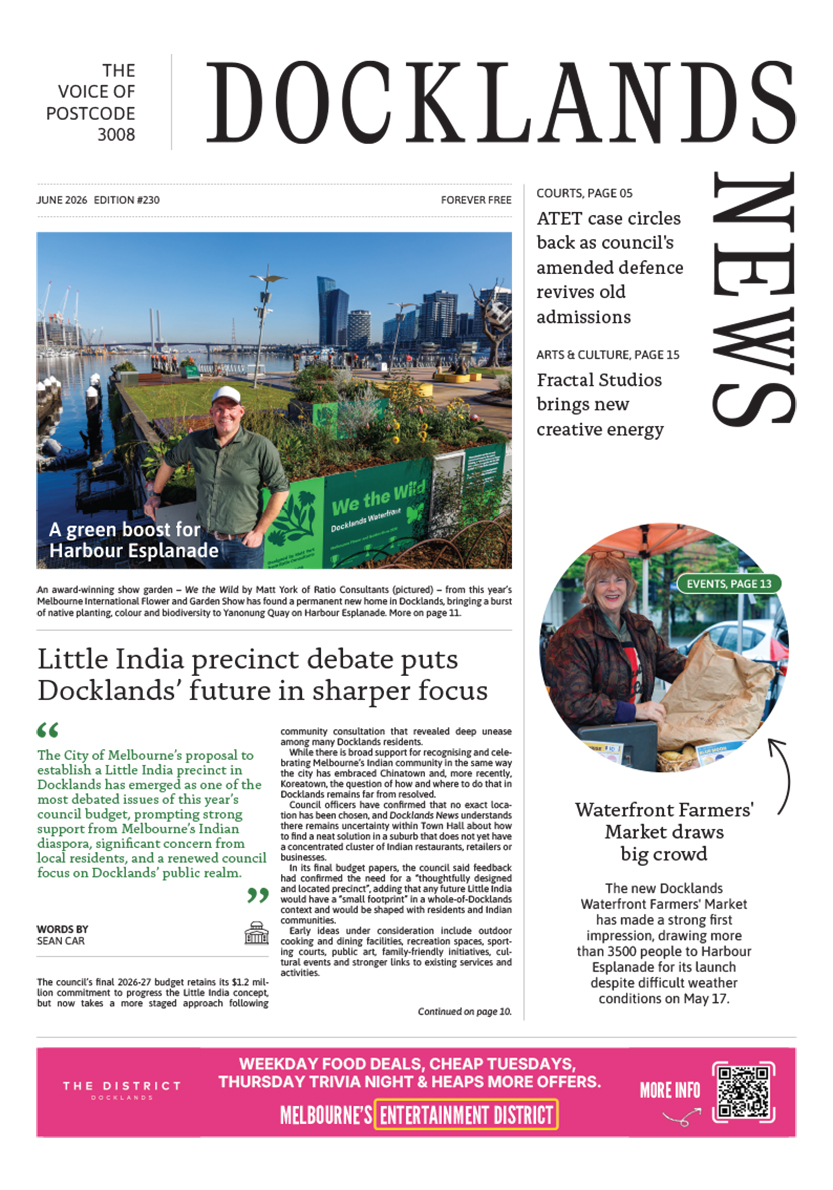
Little India precinct debate puts Docklands’ future in sharper focus

 Download the Latest Edition