
Some boats are “special”
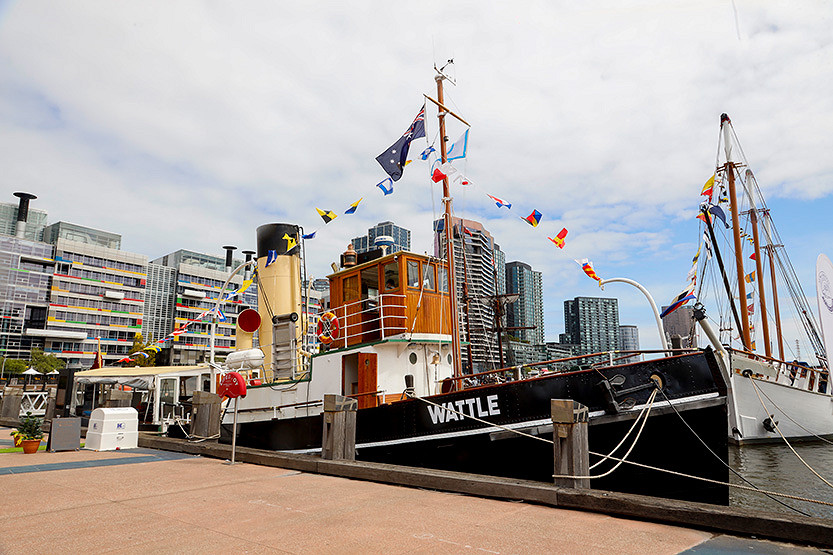

Sadly, for Victoria Harbour and Docklands community there threatens to be yet another loss of significant maritime heritage.
Melbourne Maritime Heritage Network (MMHN) is grateful to the master of steam tug Wattle captain Rob Anderson for alerting us to this fascinating maritime tale about the “rescue” of a very “special” small wooden boat was facing destruction in 2025 at the end of long, wide-ranging career on Victorian waters – Metung, Williamstown, Sorrento, Gabo Island, The Heads, Port Phillip Bay, Victoria Harbour and, hopefully back again to the Gippsland Lakes.
Although circumstances remain unclear, the tale commences with a small wooden row boat located at Sorrento being donated to serve as life-boat on ST Wattle based in Victoria Harbour. Note that the official name of the Wattle Restoration project is Bay Steamers Maritime Museum Ltd (BSMM) – the “museum” being heritage vessel Wattle. Under its own steam the Wattle sailed down to Sorrento, anchored while the small boat was rowed out and hauled aboard. The Wattle then steamed back to Victoria Harbour.
Too heavy for lifeboat purposes, it remained stowed onboard Wattle for some time (see image) before being hauled off onto North Wharf where Wattle volunteers, recognising its “special” design features, worked on restoring the boat (see picture).
Perhaps restoration work priorities changed, work on the boat paused and it was stored out of the way gathering dust in No.2 Work Shed. Work on the Wattle progressed, the “special” small boat deteriorated.
Fast forward to 2025 …
The Heritage Fleet faces eviction from North Wharf. Wattle volunteers faced hard decisions about where to relocate the vessel and where to store essential restoration materials and equipment. And – although not suitable for use on the Wattle, what to do about a clearly “special” small wooden boat? Options were limited but surely the rubbish tip was simply “NOT ON”!
For those who “know boats”, this boat had features indicating that it was clearly “special”, not only in its design, but also its purpose. Maritime restorations take a very long time. Wattle volunteers who may once have had first-hand knowledge the boat and its journey to North Wharf, were no longer at hand.
Rob Anderson was intrigued by the “special” design features and the questions which arose:
It was very heavily built, double-ended, had four oars as well as a rudder. A small dinghy doesn’t need four oars as well as a rudder?
There were filler pieces between the clinker strakes. This creates a smooth, planked external finish. Could this also indicate that perhaps it was made smooth to be able to be hauled up the side of a ship?
A very unusual feature on this boat was that it was double ended (i.e. no stern backboard). This improves buoyancy and floatation so the risk of a wave lifting up stern, causing the bow to tile downward. What boats needed such features is reduced? Was this designed for use in choppy waters?
Who would know more?
Rob was aware that Bulls brothers of Metung, had been building boats since 1912 with a reputation for building “specialist” ships for ports and harbours. Rob wondered whether this boat was the Bulls’ “special build” for the famous vessel The Rip. Perhaps it was purpose-built to specifically transport explosives necessary to blow-up rock pinnacles around the entrance to the Bay at Port Phillip Heads. In those days, explosives were highly volatile and risky to carry aboard The Rip workboat powered by internal combustion engines.
To reduce the risk a “special” heavy wooden rowboat, designed to carry explosives, was towed at a safe distance behind The Rip. Its “special” design features aligned with it being towed. A rudder would reduce drag, and its smooth planking would be easier when hauled aboard once the job was done? All the speculation at this point seemed to make sense.
Rob contacted Kim Bull, grandson of one of the earlier Bulls brothers. Rob admits that as to the purpose: “turns out I was totally wrong!”. This small boat did not serve The Rip at all (more of that at another time).
Kim Bull checked his detailed records and another fascinating purpose was revealed: “we can advise the following information was taken from the Bulls Boat List – Boat No. 228 – Gabo Island Lighthouse 12’ lifeboat clinker double-ender.”
Could this be that vessel? Further anecdotal evidence emerged some years ago, Kim’s grandfather actually visited the Wattle and recognised the small boat was Bulls-built.
Good news for Rob and the Wattle Restoration Group, Kim Bull continued: “Bulls’ would be very interested in saving the boat”. Great relief that this “special” boat will be “rescued” by Bulls and will be heading back to where it started its “career”.
Kim Bull plans to collect the boat from North Wharf later in the year. Its future? Options are under consideration – display at the forthcoming Gippsland Lakes Wooden Boat Festival (Paynesville) or in the longer term a return to Gabo Island. •
Related Articles
Changing tack in Docklands
We see plenty of “changing tack” in action in Victorian state politics currently. Nautical terms bob up in common use across aspects of life. Sailors change tack by using the wind to turn the vessel in a new direction.
Read More
Docklands: Firelight returns, and the harbour takes centre stage
Melbourne is into the coldest stretch of the year, which is precisely when Docklands does its best work – turning Victoria Harbour into a stage.
Read More
Schools in Docklands
After a regrettably long delay, we are delighted to welcome news of a new campus for Docklands Primary School. But we say, this is not enough! Now is the time to ramp up pressure on the state government for a Docklands Secondary School.
Read More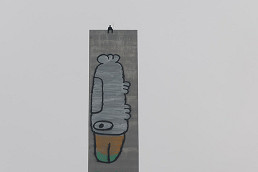
Pam the Bird disappears from Bolte Bridge following chaotic Docklands scenes
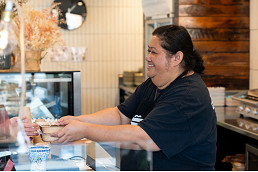
Meals with Impact launches free Docklands food market

 Download the Latest Edition